
Most ABA practices think physician referral marketing ends at the first meeting. You land an introduction with a developmental pediatrician. The meeting goes well. They say “send me your info, we’ll be in touch.” You go home, feel like you accomplished something, and never hear from them again.
Four weeks later, that relationship is dead. Not because the doctor decided not to refer. Because you stopped showing up.
Physician referral marketing is a long game. The first meeting is the start, not the win. The clinics with steady doctor-driven pipelines are the ones that built a nurture cadence and held it for a year or more. This is what that cadence looks like.
Why physician referral marketing fails at week 4
I have watched dozens of ABA practices land a great first meeting with a referral source, then disappear. The pattern is so consistent it has a shape.
Week 1: the first meeting. You leave the office feeling good. You jot down notes. You think “I should follow up next week.”
Week 2: you draft a follow-up email. You do not send it. You decide to wait until you have something to share.
Week 3: a client emergency comes up. You forget about the email.
Week 4: you remember the email. But now it feels weird to follow up because too much time has passed.
By week 6, the doctor has met four other clinic owners. By week 12, you are a vague memory. By week 24, you do not exist.
This is the silent killer in physician referral marketing. The relationship does not die because of a bad meeting. It dies because no one followed up consistently. The fix is not better meetings. It is a follow-up cadence you can hold without thinking about it.
Most ABA practices lose their best referrals at week 4.
Watching the relationships you worked hard to build go silent is the most expensive avoidable mistake in ABA growth. A-Train builds and runs the nurture cadence so it doesn’t happen.
Book a strategy meeting →The two touchpoint types you have to mix
Every nurture touchpoint falls into one of two categories. Most ABA practices only do one of them.
Value-add touches. You send the doctor or practice manager something useful. A handout on a clinical topic they asked about. A research summary. A patient education resource they can give their families. The point is, they get value before you ever ask them for anything.
Check-in touches. You stop by, send a short note, or call to update them on intake availability. These are quick and transactional. “Wanted to let you know we have two new openings starting October.” Five-second message. Easy for them to file or act on.
Most clinics either do all check-ins (which reads as pestering) or all value-adds (which never converts to actual referrals). You need both. Rule of thumb is 2 value-adds for every 1 check-in.
The 5-play monthly rotation
Pick five plays. Rotate one per month. Hold the rotation for a year.
Play 1: the patient education handout. Mail or email a one-pager on a clinical topic the doctor’s families need. Sleep, transitions, behavior plans for school, sibling dynamics. The handout has your clinic name and contact at the bottom. Doctors keep these for their families.
Play 2: the intake update. Short email or hand-delivered note. “Current intake wait time is 6 weeks. Two openings for new families in [insurance type] starting in [month].” That is it. Easy to act on.
Play 3: the case-study presentation. Lunch and learn. 20 minutes. One de-identified case showing how a family went from intake to discharge. No selling. Just walking them through your process so they understand what referring to you actually looks like for a family.
Play 4: the resource share. Something they would not otherwise see. A research summary. A local autism support event flyer. A scheduling tool. Position yourself as the source of useful information, not the vendor asking for things.
Play 5: the holiday or seasonal touch. Hand-written card during the holidays. Coffee drop in the spring. Doctor’s day in March. Personal, small, low-pressure. It builds the relationship as a relationship, not just a referral pipeline.
That is one full year of nurture. 12 touchpoints across 5 plays. Mix the order so it does not feel scripted, but stick to the rotation.
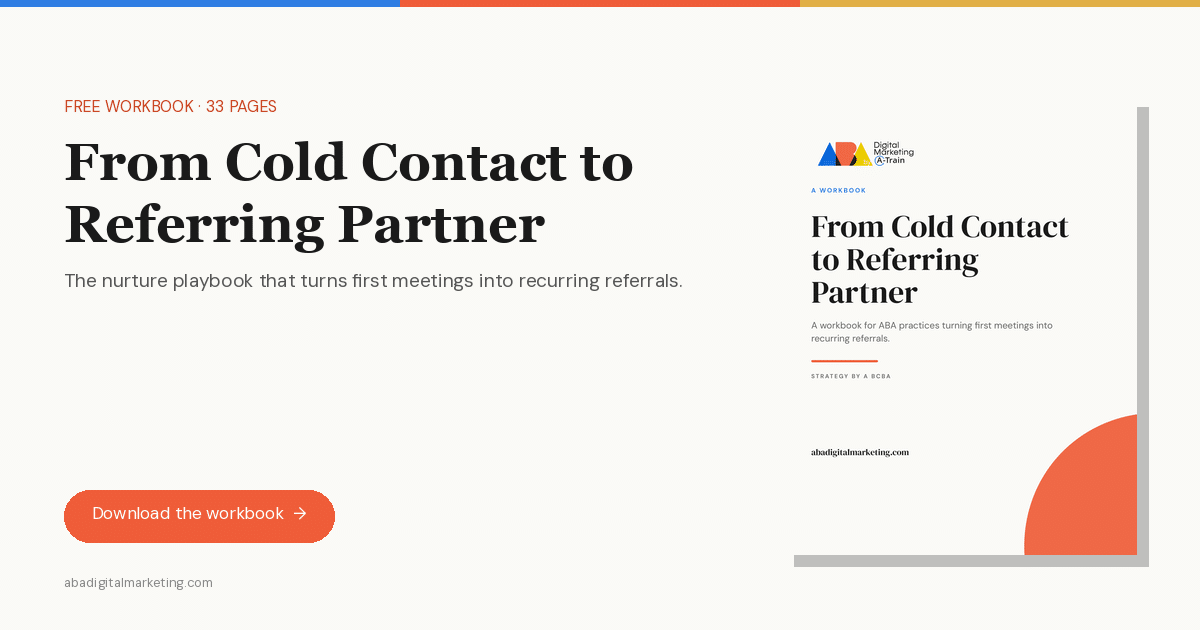
From Cold Contact to Referring Partner
The full nurture playbook — the two touchpoint types, the 5-play monthly rotation, the quarterly review template, the white-glove sequence for handling an inbound referral, and the tier-based cadence.
Get the workbook →Don’t have time for 12 touchpoints a year across 30 offices?
A-Train’s referral team can run the full 5-play rotation on your behalf — including the resource creation, the case studies, and the seasonal touches.
Book a strategy meeting →The quarterly review (and the one magic question)
Once a quarter, sit down with a notebook and your referral tracker and review every Tier 1 office on your list. For each office, ask one question.
“Has this office sent us a referral in the last 90 days?”
If yes, your job is to keep showing up. Maintain the cadence. Do not slack off because they are referring. The clinics that lose their best referral sources are the ones that get comfortable.
If no, ask the second question. “Did I do my part of the cadence?” If you did all 3 touches in the last quarter and they have not referred, the relationship is probably not going to convert. Demote them to Tier 2 or drop them. If you did not do your part, the problem is you, not them. Get back on the cadence next quarter and reassess.
The quarterly review is the difference between a referral network that compounds and one that quietly bleeds out.
The bounce network for families you cannot take
One overlooked nurture play is what to do with families you cannot serve. The kid is outside your age range. The insurance is not on your panel. Your waitlist is too long.
The default move is to say “we cannot help” and let the family figure it out. The better move is to refer them to another clinic you trust.
This sounds backwards. Why send a family to a competitor? Because doctors notice. When you tell a referring pediatrician “we could not take this family but we sent them to Clinic X who can take them this month,” you become the most useful clinic in their network. They send you more families because they know you will solve the family’s problem either way.
Building a bounce network takes ten minutes. Identify 3 to 5 other ABA practices in your area, by demographic or insurance specialty. Email them and offer to refer when you cannot take a family. Most will reciprocate. You all end up with more referrals than you would have alone.
Get the full Relationship Nurture workbook
33 pages on turning first meetings into recurring referrals. The plays, the cadence, the magic question, and the white-glove sequence. Free. Add your details and we send you the PDF.
Get the workbook →