
A parent in a Facebook group hears another mom rave about your clinic. The recommendation is glowing. The parent searches your clinic on Facebook. Nothing. Tries again with a slightly different spelling. Still nothing. Finds something that might be you, but the last post is from 2022 and the cover photo is a stock image.
The parent decides you cannot be the right place. They move on.
You just lost a family you never knew was looking. Not because someone outpitched you. Because they could not verify you were real.
That is what social media is for in ABA. Not generating leads. Not going viral. Social media for therapists is a trust layer, not a lead source. The goal is to be findable, active, authentic, and safe when a parent shows up looking. Most clinics misunderstand this and waste years posting the wrong thing.
Why social media for therapists isn’t a lead source
Most therapy practice owners read social media advice from B2B marketers. The advice is to post consistently, build a following, drive traffic to your funnel, convert followers to leads.
That advice is fine for software companies. It does not apply to clinical services for kids with autism.
The reason is the buying journey. Parents do not browse Instagram looking for an ABA provider. They hear about you from another parent, from a pediatrician, or from a moms’ group. That is where the inquiry actually starts.
What happens next is the part most clinics ignore. The parent checks your social profiles before they reach out. They are not looking for inspiration. They are looking for proof you are a real, current, trustworthy place. If they cannot find proof, the inquiry does not happen.
This is the entire mechanic of social media for therapists. Not generating leads. Stopping the inquiry from dying before it starts. Once you accept this, the system that follows is simple.
Social is the trust layer. Search is where most ABA inquiries start.
If you want more parents finding you in the first place — through Google search, paid ads, and referral networks — A-Train builds the engine that drives them to a clean social presence.
Book a strategy meeting →Stay findable (the parent-search test)
If a parent hears about you and goes to look, can they find you? Not your website. Your actual social profiles.
Run the test. Open your phone. Search your clinic name on Facebook and Instagram the way a stranger would. Did you find it? Did it look alive? If either answer is no, you have a findability problem.
The findability fix is mostly profile setup, not posting. Three things have to be true.
Your profiles exist under your real name. Facebook business page and Instagram business account, both matching the name parents heard. Same name, no weird modifiers.
Your bios are complete. Phone, address, hours, one-line description. No emojis, no inspirational quotes. Parents are checking facts, not vibes.
Your most recent post is from the last month. A blank account makes parents think you are new. A neglected account makes them think you are gone. A dead Facebook page is sometimes worse than no Facebook page.
Stay active (the 1-2 posts a week cadence)
One to two posts a week. Forever. That is the system.
The most common cadence mistakes in social media for therapists are predictable. A new clinic reads advice that says “post 5 times a week” and burns out in three weeks. Or they post nothing for six months because they have been busy. Either way, the account looks neglected at the moment a parent checks.
The math on one post a week is 52 posts a year. Two posts a week is 104. Either is enough to look alive every time a parent checks. Neither is enough to burn anyone out.
The hard part is sustaining it. Most clinics can post twice a week for a month. Almost none can do it for a year without a system. That system is one named person owning the posting, a recurring calendar slot, a scheduling tool (Meta Business Suite works for free), and a backup poster for when the named person is out.
Pick the cadence you can hold. The cadence you can hold beats the dream cadence you cannot.
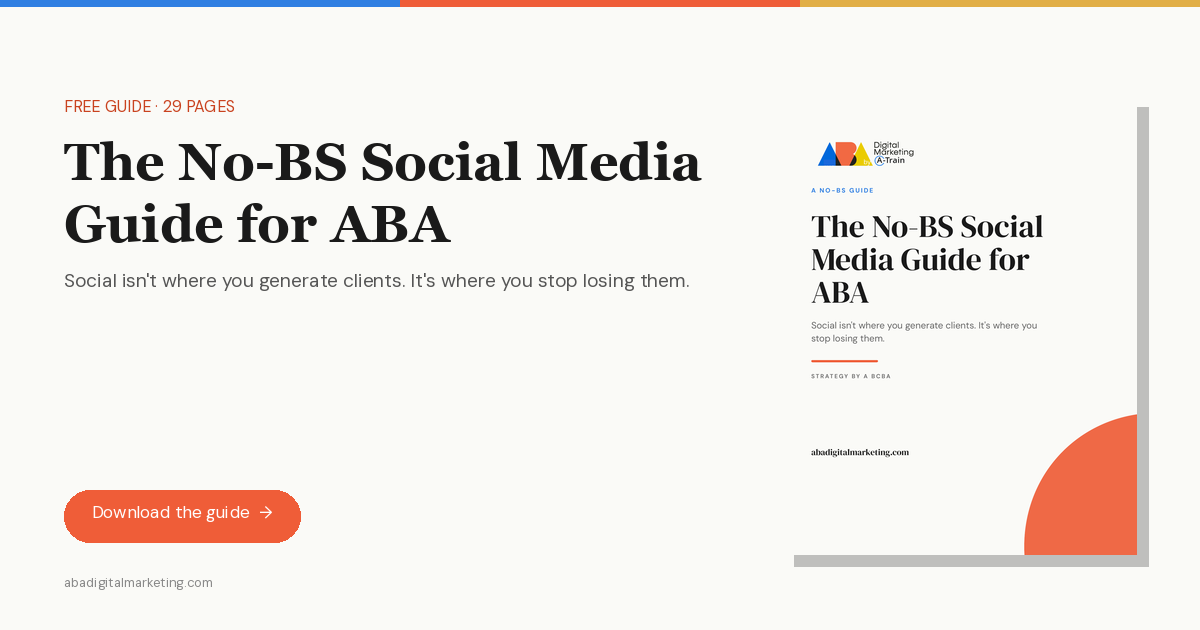
The No-BS Social Media Guide for ABA
The full four-part system — findable, active, authentic, safe. Profile audits, the 5-step posting infrastructure, content authenticity checks, photo release rules, and a Friday content-capture walkthrough.
Get the guide →Stay authentic (less Canva, more real)
Most ABA clinics make the same mistake. They open Canva. They spend an hour designing a graphic with a quote about behavior. They post it. They get three likes.
Then they wonder why social media is not working.
The graphic looked fine. That is the problem. It looked too fine. Polished, stock, on-brand. It read as marketing, not as evidence.
Parents are not flipping through your feed for inspiration. They are looking for proof you are real. A photo of your actual sensory room beats a stock photo of a happy child every time. A blurry phone video of staff setting up beats a 30-second animated explainer. A photo of a craft drying on a counter beats a Canva template that says “Crafts build fine motor skills!”
The rule is simple. If a parent could not tell whether your post was made by your clinic or a marketing company, you posted the wrong thing.
Authentic content does not have to be pretty. It has to be specific. A photo of your specific clinic, your specific staff, your specific work. The specificity is what makes parents trust you. The polish is what makes them suspect you.
Authentic social only matters if your whole brand feels real.
A-Train’s free brand audit checks whether your website, social, and search presence read as one trusted clinic or three disconnected pieces.
Book a strategy meeting →Stay safe (the photo release rule)
If a child’s face is visible in any post, you need a signed photo release from the caregiver. Specifically for social media use. Not the general clinic photo release. A separate, explicit one.
Most clinics get this wrong in three ways. They use the general clinic release and assume it covers Instagram (it does not). They blur the face poorly (still recognizable, still requires release). Or they post a photo with a child in the background, thinking it does not count (it does).
The fix is two parts. Build release language into your intake paperwork from day one. Every new family signs it. Renew yearly. Then build a content library of posts that do not require a face. The library should be deep enough that you never feel the need to push a borderline photo.
Three buckets of content you can always post without a release: clinic spaces, staff at work, activities and materials. Build your library here and you never have to push a borderline kid photo.
There is no upside to skipping a release. The downside is a parent complaint to the state board, a HIPAA inquiry, or a lawsuit. Even one of these ends the conversation about social media for a year.
Get the full No-BS Social Media Guide
29 pages on the trust-layer playbook. The four parts, the audits, the cousin test, and the compliance ASSESS. Free. Add your details and we send you the PDF.
Get the workbook →