
The most common mistake I see when ABA practices try to get referrals from doctors is what I call brochure theater. The owner prints 200 brochures, drives to 30 pediatric offices, drops them at the front desk, and waits. Three months later, they have not gotten a single call.
The brochures are fine. The problem is that 30 offices is the wrong number, the drop-off is the wrong move, and waiting three months without a second touch is the wrong cadence.
Doctors do not refer to ABA practices because they got a brochure. They refer to practices they trust. And trust gets built across multiple touchpoints over time. The clinics that get steady physician referrals pick the right offices, visit with the right script, and follow up enough times to actually land in the doctor’s memory.
Why most ABA referral outreach fails
Most ABA owners do referral outreach the way a college student does flyering. Print stuff. Hand it out. Hope. That approach fails for three reasons.
The first reason is targeting. Not every pediatric office is worth your time. A general pediatrician sees a child with developmental delays and refers to a developmental pediatrician for the diagnosis. The developmental pediatrician is the one who routes that family to ABA. If you spend your outreach time on general pediatricians, you are two steps removed from the actual referral decision.
The second reason is the drop-off itself. Walking in, handing brochures to the front desk, and walking out does almost nothing. The front desk has no clinical context. They put your brochure on a stack with 50 other vendor flyers. The doctor never sees it. Even if they did, a one-time exposure to a brochure does not move them to refer.
The third reason is follow-up. Most ABA practices visit an office once and stop. According to BACB certificant data, the number of certified BCBAs in the US has more than doubled in the last seven years. That is more practices competing for the same pediatrician’s attention. One visit is not enough. Most referral relationships take 5 to 7 touches before they convert.
The 3-tier system for picking offices
Before you visit anyone, write down every pediatric office within 15 miles of your service area. This will be 30 to 60 offices in most markets. Then sort them into three tiers.
Tier 1 (50 percent of your time). Developmental-behavioral pediatricians, pediatric neurologists, and any office that publicly mentions autism, neurodivergence, or developmental delays on their website. These offices route 4 to 8 times more ABA referrals than a general pediatrician because they are the ones doing the diagnostic workups that send families to ABA in the first place.
Tier 2 (30 percent of your time). Larger pediatric practices (4 or more providers) and offices that accept the same insurance panels you do. These will not refer as densely as Tier 1, but they have the volume to make up for it.
Tier 3 (20 percent of your time). Solo pediatricians, family medicine practices that see kids, and any office that came up in a parent referral conversation. These are lower yield but cheaper to maintain once you have a relationship.
The number to remember is 10. You want 10 offices on your active outreach list at any time, weighted toward Tier 1. Trying to work 30 offices means working none of them well.
Don’t have time to score 30 offices and run the visits?
A-Train’s growth team builds the targeting analysis for your service area and runs the outreach cadence on your behalf. You stay focused on clinical work.
Book a strategy meeting →The 90-second drop-by that actually works
The drop-by is your first real touch with an office. Done right, it earns you a second meeting. Done wrong, it goes nowhere.
Walk in. Do not call ahead. Calling ahead lets the office say no. Walking in gets you past the gatekeeper. Bring coffee or donuts. Empty-handed visits get treated like vendor visits.
Ask for the practice manager. Not the doctor. Not the front desk. The practice manager is the gatekeeper to the doctor’s referral patterns and is usually free for five minutes.
Open with the 90-second ask. “Hi, I’m a BCBA who just opened a practice in town. Could I leave some referral cards with you? It will take 90 seconds.” Saying the time triggers a yes. Most managers will give you 90 seconds because it sounds short.
Hand them your one-page tear-sheet. Not a brochure. A single sheet, heavy stock, with your name, credentials, insurance panels, current intake wait time (be honest), and a direct phone number. The point is not to teach them ABA. It is to give them the data they need to confidently refer a family.
Ask one question. “Are there populations you have been struggling to find ABA support for?” Listen. Take notes after you leave. Do not pitch. Do not stay longer than 90 seconds.
The whole purpose of the visit is to leave the office with the practice manager remembering you as the one person who did not waste their time.
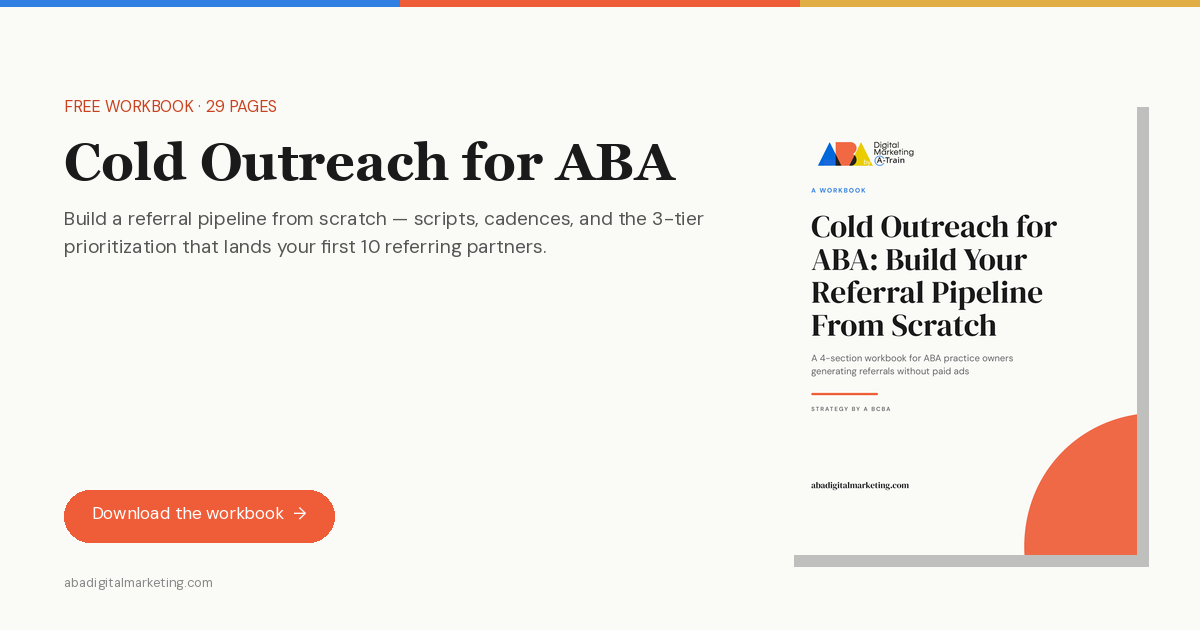
Cold Outreach for ABA
The full system — the 3-tier prioritization sheet, the tear-sheet template, the 5-7 touch cadence, objection-handling scripts, and the tracking sheet you can copy on day one.
Get the workbook →The 5-7 touch math (and why one drop-off does nothing)
One drop-by gets you in the door. It does not get you referrals. Most pediatrician relationships convert at 5 to 7 touches, not one. Here is what those touches look like over the first 90 days.
Week 1: the 90-second drop-by. The visit above.
Week 2: a thank-you note. Hand-written, on a card, mailed (not delivered). Mention one thing from the conversation so they know you were listening.
Week 4: a useful resource. Email the practice manager a one-page handout on a specific topic the doctor mentioned. Sleep protocols, school-based behavior plans, transition supports. Pick something useful, not a sales doc.
Week 8: a second drop-by. Same script, but this time bring an update. “Wanted to let you know we just opened up 3 spots for new families starting in [month].” Specific, time-bound, easy to act on.
Week 12: a case-presentation lunch ask. “Would you have 20 minutes over lunch sometime in the next month? I’d love to walk through a de-identified case to give you a feel for how we work.” This is where the actual referral relationship usually starts.
Most ABA practices never make it past week 1. The ones that get steady referrals are the ones that just keep showing up.
Let someone else run the 90-day cadence.
A-Train’s pediatrician outreach service handles the visits, the thank-you notes, the second drop-bys, and the case-presentation asks. We report back monthly.
Book a strategy meeting →Tracking what works (the simple version)
You do not need a CRM. A Google Sheet with five columns is enough.
Office name. Tier. Last touch date. Next planned touch. Has referred yet (yes or no).
Update it every Friday. After 60 days of tracking, you will see which tier is actually sending referrals (often a surprise), which staff member at your clinic is the strongest visitor (also often a surprise), and which offices to drop because they will never refer.
The Friday update is the whole system. Practices that do it for a year always have a steady referral pipeline. Practices that do not, do not.
Get the full Cold Outreach workbook
29 pages of scripts, cadences, the 3-tier prioritization sheet, the tear-sheet template, and the tracking system. Free. Add your details and we send you the PDF.
Get the workbook →