
A parent called us at 2:00 on a Wednesday afternoon. I was in a session and missed it. The next morning I had caregiver training. Then more meetings. That is how a clinic director’s day goes.
I called her back late Thursday. She told me she had already started with another clinic. She liked our website. She said if it did not work out there, she might call us back. She never called back.
The other clinic did not have a contract with her. Nothing was stopping her from coming to us. But by the time we talked, she had already filled out their forms, signed their consents, and sent over her child’s diagnosis. She felt started. That feeling matters more than any paperwork.
That is the whole game. ABA intake is a race. The clinic that makes a family feel started first usually keeps them. And the race begins the moment a parent lands on your website. Three things decide whether you win or lose it. Your form, your response time, and your honesty about what comes next.
Why long patient intake forms lose ABA clients
Most ABA clinics build their website’s patient intake form like a paperwork checklist. Insurance type. Home or clinic. Date of birth. Diagnosis status. Hours per week needed. Best time to call. The logic is, “we need all this information anyway, so let’s get it up front.”
That logic costs you clients.
A parent of a child with autism does not have time to spare. They might be filling out your form during a five-minute break between meltdowns. If your form has 30 fields, they close the tab. If it has three, they submit it.
Your website’s patient intake form has one job. Start a conversation. That is it. Everything clinical waits for the call.
That form sits on a landing page, and the page has to do its job first. I cover the answer block, the promise near the button, and the callback clock in how to build an ABA therapy landing page that converts.
The 5-field rule (the only fields you need)
The intake form on your website should have no more than 5 fields. Three are required, two are optional. That is it.
Required: name, email, phone. That is the minimum to call a family back. Three fields. Nothing else.
Optional: child’s age, ZIP code. These help you route the lead before the first call. Useful but not worth scaring anyone off over.
That is the whole form. No dropdowns. No insurance picker. No “how did you hear about us.” No diagnosis questions. Everything else gets asked on the call.
If a tired parent had 30 seconds and one hand free, could they finish your form? If the answer is no, your form is the reason you are not converting.
Your intake is lean. The next question is volume.
A clean intake matters only if there are enough inquiries flowing through it. A-Train builds the multi-channel growth engine that drives qualified families to your form.
Book a strategy meeting →The 24-hour speed-to-lead floor
Once the form submits, the clock starts. Three minutes is what elite clinics do (auto-text replies, on-call intake staff, response routing). Twenty-four hours is the floor. Anything slower and the family is already calling someone else.
Most ABA practices are slow. You do not have to hit three minutes to win. You just have to beat the other clinics in your area. A clinic that always responds inside one business hour will beat almost every competitor.
The infrastructure to hit that standard is simple. One person is named as the first responder. The form triggers an email or text to that person within five minutes. The auto-confirmation on your form tells the parent when to expect a call. Weekend submissions get a Monday morning response, not a Tuesday one.
Set the standard your team can actually hold. Pick the number, write it on the wall, and track it weekly. The standard you can hold beats the dream standard you cannot.
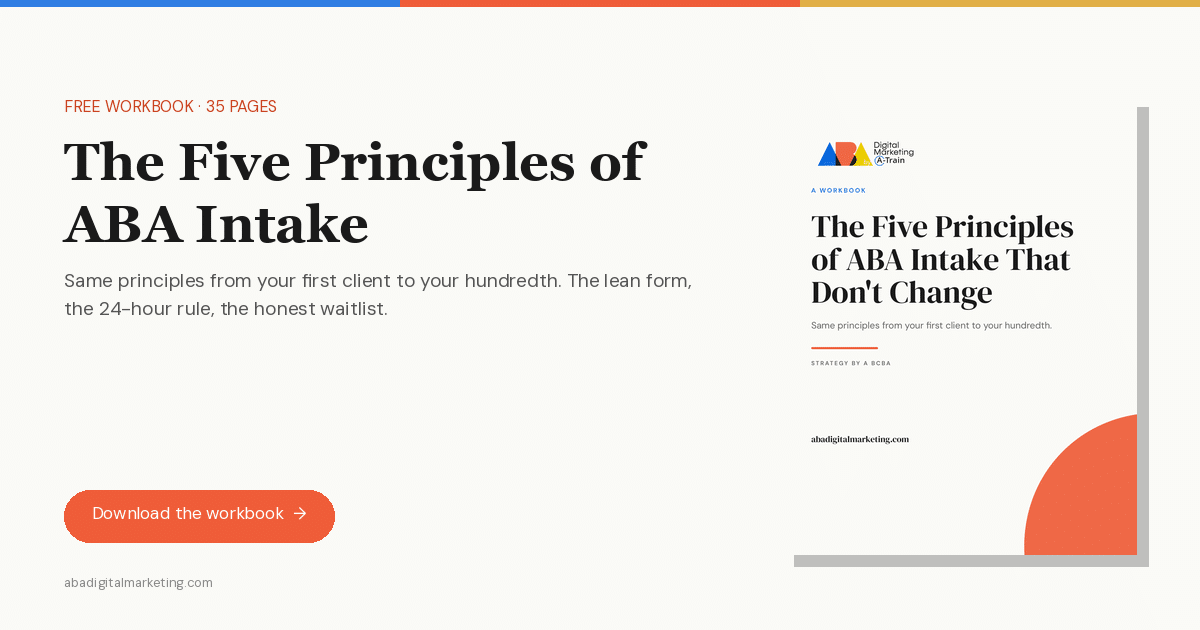
The Five Principles of ABA Intake That Don’t Change
The full workbook on the lean form, speed to lead, helpful follow-up, empathy as an operating standard, and the three lists every honest waitlist actually needs. Same principles whether you have your first client or your hundredth.
Get the workbook →The four-touch follow-up that catches buried families
A family does not always respond on the first try. Most clinics give up after one call. The clinics that win follow up four times, sometimes more.
Touch 1: a first text or email, within 24 hours. Use the parent’s name. Acknowledge the inquiry. Tell them what is coming next. “Hi [Name], saw you submitted a form on our site about ABA for [child’s name]. I’ll be calling you very soon. Looking forward to chatting.” Send this before the day ends, no matter what.
Touch 2: the first phone call, days 1 to 2. Warm and curious. Ask what brought them to ABA. Ask what their timeline looks like. Listen more than you talk. If they pick up, the call moves into qualification.
Touch 3: switch channels, day 5 to 7. If they did not respond, change the medium. Text becomes email or a call. If they are waiting on a diagnosis, offer to walk them through what the process looks like once the diagnosis lands. Useful follow-up keeps you on their mind during the wait.
Touch 4: the closeout, day 10 to 14. “Hi [Name], I wanted to follow up one last time to make sure you are not still interested in ABA. If anything changes, reach back out.” This is the message that catches the parents who got buried. More families respond to the last touch than you would expect.
Want a full look at your current marketing pipeline?
A-Train’s free growth audit looks at where your inquiries come from today, where the biggest leaks are, and where the next 50 families could come from.
Book a strategy meeting →The honest waitlist (three lists, not one)
Most clinics keep one list. Every family that reaches out goes on it. That list is a lie.
A real intake operation has three lists.
List 1: Showing interest and getting in touch. Families who reached out, took a call, started the conversation. You do not yet have the paperwork to know if they qualify. These families need helpful follow-up while you figure it out.
List 2: Waiting on paperwork. They are engaged. The diagnosis is in progress. Insurance verification is pending. Some piece of documentation is in motion. They will probably qualify. But they cannot start today.
List 3: Qualified and ready. Every piece of paperwork is in. The minute a spot opens, you can start service. This is your real waitlist when you do not have capacity.
The mistake almost every clinic makes is collapsing all three into one. They put the family who called yesterday on the same list as the family whose paperwork is complete. Then a spot opens, they call the first family, and find out they do not even have a diagnosis. Your waitlist is now a guess, not data.
The clinics that build trust with parents are the ones that can answer “how long is the wait” with a real number. The polite answer breaks trust. The honest answer builds it.
Get the full ABA Intake Principles workbook
35 pages on the five principles, with audit prompts, ASSESS grids, and a 5-step weekly waitlist cleanup. Free. Add your details and we send you the PDF.
Get the workbook →